
It’s been a while since I last posted anything here. Many reasons for that. I’m still receiving physical therapy from a bad fall last August that led to hip surgery. And my church work load has increased in unprecedented scope as I’ve been doing catechesis with some very eager new entrants into the Orthodox faith. Most of my writing has been limited to church publications and mailing lists. But I missed writing here in WordPress and if you’re still subscribers to this WordPress site, I hope you can still find value in something I write here.
I am an Orthodox Christian, and I have a valuable reference resource from which I can draw wisdom. And that resource of course is the wisdom of 2,000 years of Christian saints and theology. That’s why I renamed this as Ancient Modern Faith from its previous name Ancient Answers. I guess either way, I betray my allegiance to the ancient part of my Orthodox faith. But I also need to express it in today’s terms. Not out of a desire to be relevant. I don’t particularly care whether I’m relevant or irrelevant.
So today, March 4th, the Orthodox Church celebrates a venerable ancient saint who might not impress as particularly relevant: Gerasimus of the Jordan. Here is how this saint is remembered in the Prologue of Ohrid, a very valuable anthology of writings and lives of saints compiled by St. Nikolai (Velimirović) of Ohrid about a hundred years ago.
The Venerable Gerasimus
This remarkable and renowned saint first learned about the ascetic life while he was in the Egyptian Thebaid. He then went to the Jordan and founded a community in which there were seventy monks. This community still exists today. He instituted a special rule for his monastery. According to this rule the monks spent five days a week in their cells weaving baskets and rush mats. They were never allowed to light a fire in their cells. Five days a week they ate only a little dry bread and a few dates. The monks were required to keep their cells open so that, when they went out, anyone could enter and remove whatever he needed from their cells. On Saturdays and Sundays they gathered in the monastery church. They had a common meal with a few vegetables and a little wine to the glory of God. Each monk would then bring in and place before the feet of the abbot that which he had made during the past five days. Each monk had only one robe. St. Gerasimus was an example to all. During Great Lent he did not eat anything except what he received in Holy Communion. On one occasion, he saw a lion roaring from pain because of a thorn in his paw. Gerasimus drew near to the lion, crossed himself and removed the thorn from the animal’s paw. The lion became so tame that he returned with Gerasimus to the monastery and remained there until the elder’s death. When Gerasimus reposed, the lion succumbed to sorrow for him and died. Gerasimus attended the Fourth Ecumenical Council [Chalcedon, 451] during the reign of Marcian and Pulcheria. Although at the beginning Gerasimus leaned toward the Monophysite heresy of Eutyches and Dioscorus (St. Euthymius dissuaded him from this heresy), he was a great defender and champion of Orthodoxy at the Council. St. Gerasimus died in the year 475, and passed on to the eternal joy of his Lord.
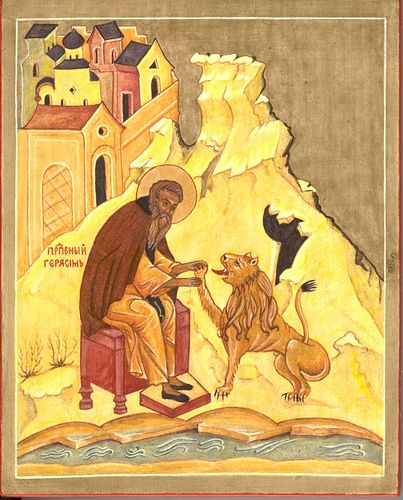
A remarkable life indeed, much beyond anything we can recognize. So not particularly relevant to our lives. Or is he? Are we not inspired by his commitment to simple living, simple eating, and the centrality of the Eucharist in the practice of his monastery? Though our lives are not as basic as his, the Eucharist can and should be the center of our lives as Orthodox (or Catholic) Christians. Here is a Contemplation by St. Nikolai that I feel is appropriate at this time, as more and more of us return to the Eucharist after the disruptions of Covid four years ago.
Contemplate the Lord Jesus at the Mystical Supper:
1. How He chose bread and wine, two ordinary elements of nourishment, and through them instituted His visible and invisible bond with the Church until the end;
2. How the Mystical Supper has been preserved until today, and how it will be preserved until the end of time as the Mystery of Communion;
3. How every day, and almost every hour, somewhere in the world, a priest consecrates the bread and wine and receives them as the Body and Blood of Christ. What a wonderful vision that is!
We need the Eucharist more than ever, because it is proof of the promise the Lord Jesus made to be with us until the end of the ages. And we will continue to be nourished by the Eucharist until the Lord returns! We will know him when he comes because we receive him and hear him every time we are at Liturgy. Did you ever think of that? Well think about it, as I offer it for your consideration today. You are blessed if you worship in a liturgical church, whether Orthodox or Catholic or a Protestant church that still offers the Eucharist. Nothing gives me greater joy on a Sunday morning than seeing the face of a loved friend and brother or sister in the faith approach to receive the Body and Blood of Christ. It is very much a foretaste of eternal life in the midst of God’s eternal congregation.
The Eucharist suffered during the Covid scare. In my congregation we acted reasonably and responsibly to allay fears. But this was just one more blow that traditional Christianity received. I thank God that among our congregants at least 70% have come back to regular participation. And some of those who have not come back have not done so because of age or physical and health decline. But let’s be honest. Christianity is on the decline, as the increasing ‘nones’ in our society demonstrate. And make no mistake, Christianity is under attack – not in the silly ways that Fox News peddles, but at a much more profound and fundamental level that perverts the minds and hearts of millions; nay, hundreds of millions.
Is Christianity anti-intellectual, as the pseudo-intellectuals of today proclaim? Well yes, if you’re talking about the versions of Christianity that you are likely to encounter in most mega-churches or hear from most well-paid sleazy preachers and televangelists. I defer again to St. Nikolai to answer both ‘intellectuals’ and ‘anti-intellectuals’:
If the philosophies of men were able to satisfy man, why did the philosophers Justin and Origen become Christians? Why did Basil, Chrysostom and Gregory, who in Athens studied all the philosophy of the Greeks, receive baptism? And why did Blessed Augustine, who knew the wisdom of both the Greeks and the Romans, throw away all and seek salvation and illumination in the Christian Faith? And St. Clement of Rome, who was very wealthy and very learned? And St. Catherine, who was from the royal house and knew all the worldly wisdom of the Egyptians? And the young Crown Prince Ioasaph in India, who knew all the Indian philosophies? And many, many more who, in philosophy, primarily sought explanations to the puzzles of the world and illumination for their souls, and afterward entered the Church and worshiped the Lord Christ?
Indeed, why? All the examples St. Nikolai offers are from the ancient church. But there are many today as well, who daily find truth and sustenance for life in the ancient faith handed down to us. I see it first-hand as thinking men and women escape the “dictatorship of relativism” Pope Benedict XVI so brilliantly confronted in his all-too-brief pontificate. To them the ancient faith is not so ancient after all. It fortifies them to live each day fully and meaningfully. Don’t let any pseudo-intellectual or politically correct nonsense convince you otherwise. God is the Lord and has revealed himself to us. Blessed is he, or she, who comes in the name of the Lord. You are blessed. Come in the name of the Lord. Come where you are prized to share in the fellowship of saints.
 Ancient Answers
Ever a student of the arc of Christian thought and spirituality over the last two millennia – I appreciate your post today. I hadn’t realized that it was Pope Benedict who coined the phrase “dictatorship of relativism”. This is of special interest to me as stand against the current of our generation’s dogmas of modernism:(https://moreenigma.com/2018/09/12/poking-the-eye-of-modern-day-hubris-dogmas/ ).
I also appreciate your contemplative questions concerning the “Mystical Supper”, and thanks for sharing with us Gerasimus of the Jordan – a saint otherwise unknown and unappreciated.
Hello, Rusty. It’s wonderful to be sharing thoughts with you again. It’s been a while. As far as I know it is Pope Benedict who coined the term. Here is a reference that indicates so much: https://www.catholiceducation.org/en/culture/catholic-contributions/dictatorship-of-relativism.html. Thank you for the link to your post of Sept 2018. Excellent! I have to admit that in those days I did not see as clearly as I do now the dictatorial dogmatism of the left, partly for the reason you apologetically offer in your post, not to appear as giving a blanket – or, in my case, any – endorsement to Donald Trump. But the last few years, believe me, have shaken me wide awake to what we face. Pope Benedict has become one of my heroes. During his pontificate I didn’t give him much notice, poisoned as I was by leftist and liberal-Catholic propaganda against him. But I have since found him to have been a truly remarkable theologian and man of God. Thank you for commenting. I’m sure we’ll interact many times, as we used to. I don’t think I’m going to do much with Siubstack. WordPress is more home for me!
I forgot to ask about the quote from von Balthasar. What is the source, do you know?
The quote from von Balthasar comes from his fine little booklet (only 75 sumptuous pages), and his last work before his death: “Unless you become like this child”, p.43 (first paragraph of chapter 5, “Living as God’s Children”).